

Editor-reviewed by Ahmad Zaidi based on analysis by TransforML's proprietary AI
CEO, TransforML Platforms Inc. | Former Partner, McKinsey & Company
How are Microsoft Azure, Amazon AWS, and Google Cloud using Generative AI to redefine enterprise productivity?
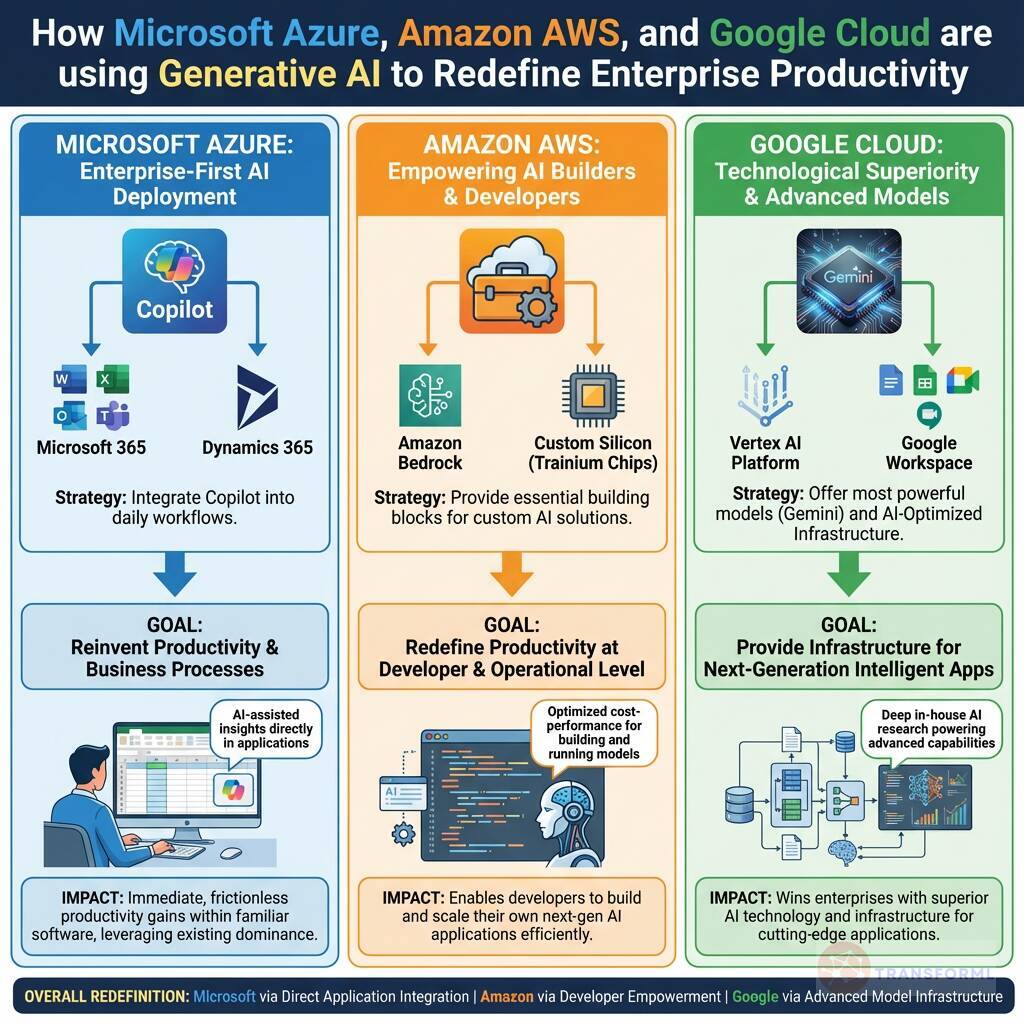
Microsoft, Amazon, and Google are embedding Generative AI into their cloud offerings with distinct strategies to boost enterprise productivity. Microsoft's approach is the most direct, focusing on an "Enterprise-First AI Deployment" by integrating its AI assistant, Copilot, into the daily workflows of its massive Microsoft 365 and Dynamics 365 user bases. This strategy, under the goal to "Reinvent Productivity and Business Processes," aims to provide immediate, frictionless productivity gains within familiar applications, effectively using its existing software dominance as a distribution channel for its Azure AI services.
In contrast, Amazon and Google take a more foundational approach. Amazon AWS focuses on empowering developers to build their own AI solutions, providing the essential building blocks through services like Amazon Bedrock and optimizing cost-performance with custom silicon like its Trainium chips. This redefines productivity at the developer and operational level. Google Cloud competes on technological superiority, leveraging its deep in-house AI research to offer advanced models like Gemini via its Vertex AI platform. While also integrating AI into Google Workspace, Google's core strategy is to win enterprises by providing the most powerful and "AI-Optimized Infrastructure" for building next-generation intelligent applications.
Review detailed strategy and competitive analysis of companies in Cloud Infrastructure Providers
Source and Disclaimer: This article is based on analysis of Annual reports and other publicly available information. For informational purposes only (not investment, legal, or professional advice). Provided 'as is' without warranties. Trademarks and company names belong to their respective owners.