

Editor-reviewed by Ahmad Zaidi based on analysis by TransforML's proprietary AI
CEO, TransforML Platforms Inc. | Former Partner, McKinsey & Company
Private AI vs. On-Device AI: How are Broadcom and QUALCOMM shaping the future of enterprise Artificial Intelligence?
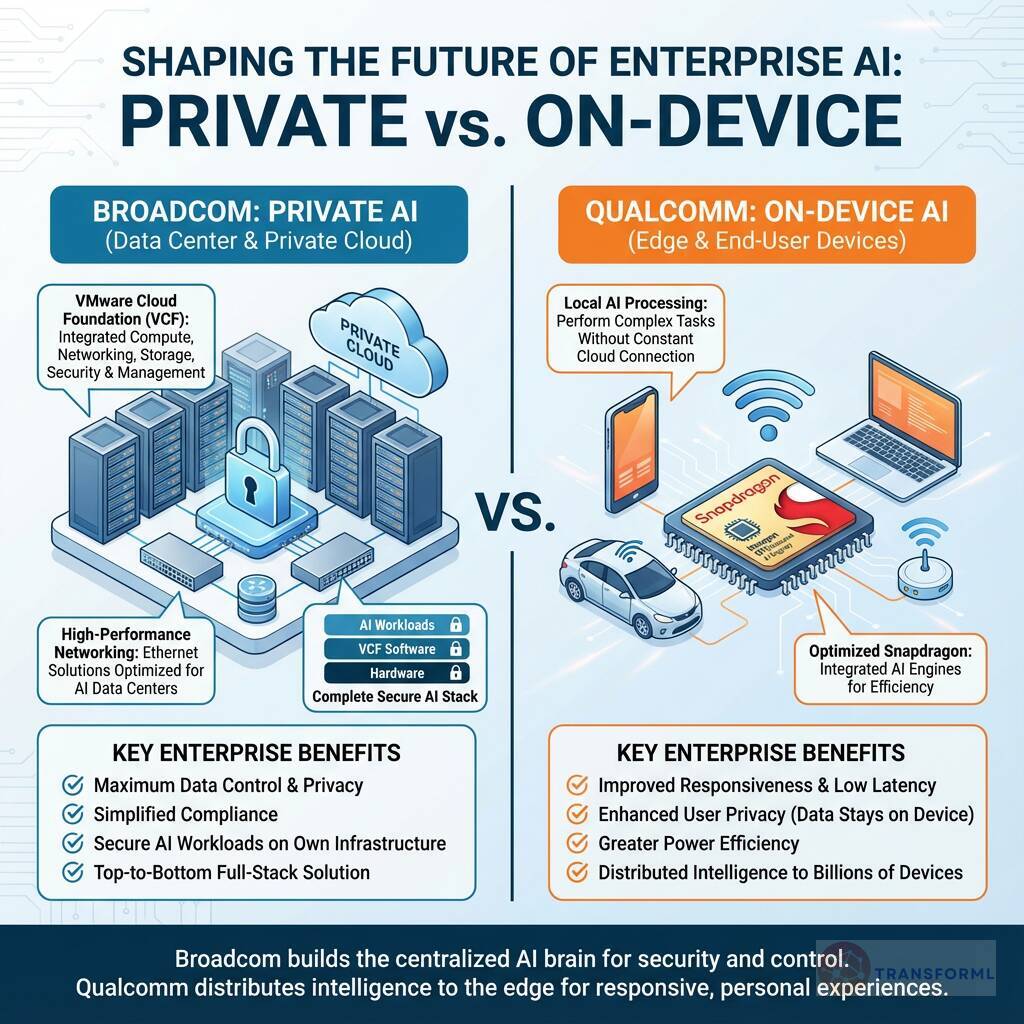
Broadcom is shaping the future of enterprise AI by focusing on "Private AI"—a strategy centered on the corporate data center and private cloud. Leveraging its transformative acquisition of VMware, Broadcom aims to "Deliver Integrated, Enterprise-Class Compute, Networking, Storage, Management, and Security through VMware Cloud Foundation (VCF)." This approach allows enterprises to run AI workloads on their own infrastructure, providing maximum control over sensitive data, ensuring privacy, and simplifying compliance. Broadcom's strategy is to provide a complete, secure, top-to-bottom stack for AI, from high-performance networking hardware like "Ethernet Solutions Optimized for AI Data Centers" to the software layer that manages it all. This full-stack solution is designed for large organizations that prioritize security and control over their AI destiny.
In contrast, QUALCOMM is shaping the future of AI from the edge in, with a focus on "On-Device AI." Capitalizing on its legacy in low-power, high-performance mobile computing, QUALCOMM's strategy is to "Optimize Snapdragon for On-Device AI." This involves integrating dedicated AI engines, like the Hexagon NPU, directly into its chips. This allows devices such as smartphones, PCs, and cars to perform complex AI tasks locally without needing to constantly connect to the cloud. The key benefits are improved responsiveness, enhanced user privacy, and greater power efficiency. While Broadcom builds the powerful, centralized AI brain for the enterprise, QUALCOMM is distributing intelligence to the billions of connected devices at the edge, enabling a different, more personal class of AI experiences.
Review detailed strategy and competitive analysis of companies in Connectivity & Networking Chips
Source and Disclaimer: This article is based on analysis of Annual reports and other publicly available information. For informational purposes only (not investment, legal, or professional advice). Provided 'as is' without warranties. Trademarks and company names belong to their respective owners.