

Editor-reviewed by Ahmad Zaidi based on analysis by TransforML's proprietary AI
CEO, TransforML Platforms Inc. | Former Partner, McKinsey & Company
Azure vs. AWS vs. Google Cloud: What are their unique strategies for winning the enterprise customer?
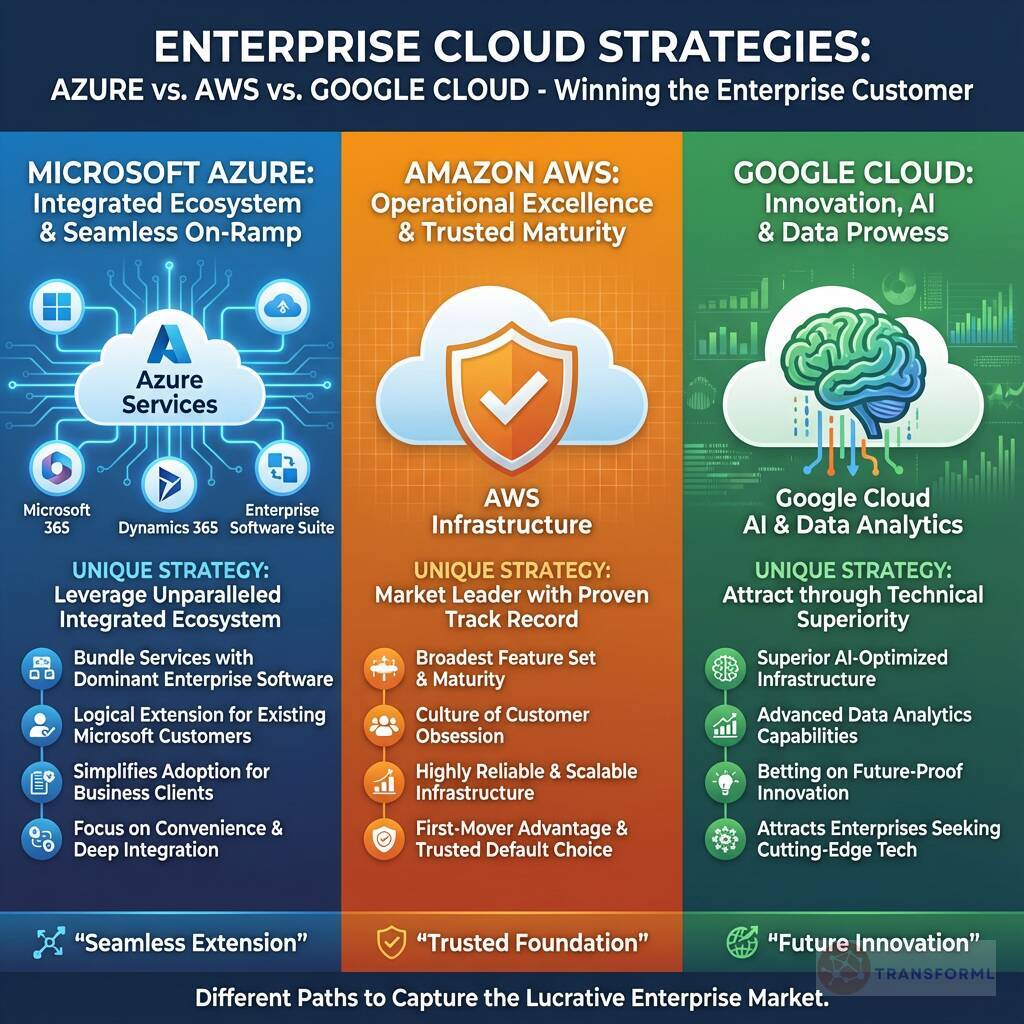
The three cloud giants employ fundamentally different strategies to capture the lucrative enterprise market. Microsoft Azure's primary strategy is to leverage its "unparalleled integrated ecosystem." By bundling Azure services with its dominant enterprise software like Microsoft 365 and Dynamics 365, it creates a powerful and seamless on-ramp for its existing millions of business customers. This integration is its key distinctiveness, making the adoption of Azure a logical and often simple extension for companies already embedded in the Microsoft ecosystem.
Amazon AWS, the established market leader, wins enterprise customers through its reputation for "Operational Excellence," maturity, and the market's broadest feature set. Its strategy is rooted in a culture of "Customer Obsession," providing highly reliable and scalable infrastructure that enterprises trust. AWS's first-mover advantage and proven track record make it the default, trusted choice for many large organizations. Google Cloud, as the challenger, competes on innovation and technical prowess. Its strategy is to "Attract Enterprise Customers" by offering superior capabilities in AI and data analytics, betting that enterprises will choose its platform for its "AI-Optimized Infrastructure" and advanced tools, even if it means switching from a more established provider.
Review detailed strategy and competitive analysis of companies in Cloud Infrastructure Providers
Source and Disclaimer: This article is based on analysis of Annual reports and other publicly available information. For informational purposes only (not investment, legal, or professional advice). Provided 'as is' without warranties. Trademarks and company names belong to their respective owners.