

Editor-reviewed by Ahmad Zaidi based on analysis by TransforML's proprietary AI
CEO, TransforML Platforms Inc. | Former Partner, McKinsey & Company
Unlocking a 360-Degree Customer View: How do Salesforce's Data Cloud and Microsoft's Intelligent Data Platform compare for unifying enterprise data?
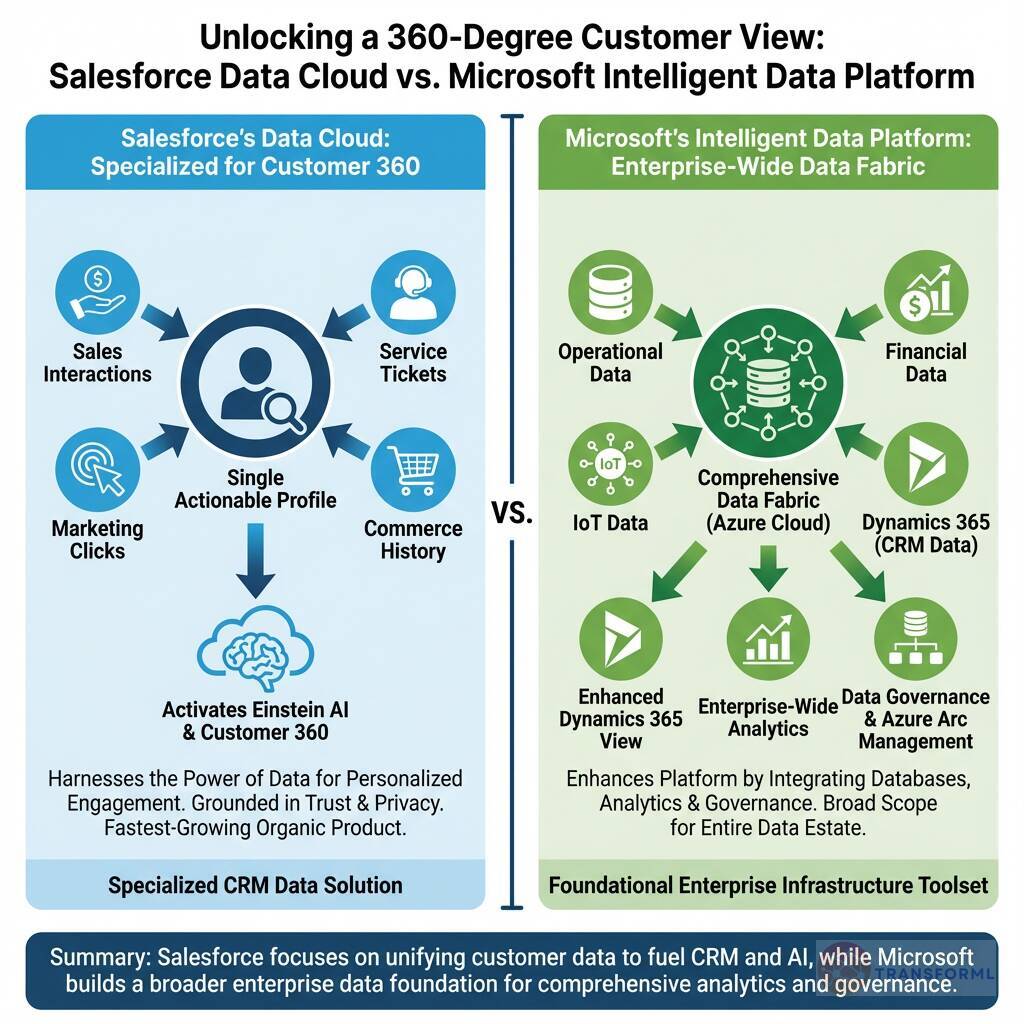
Salesforce's Data Cloud is strategically positioned as a fast and secure on-ramp to creating a unified, 360-degree view of the customer. Its central objective is to Harness the Power of Data specifically to fuel the Customer 360 platform and its Einstein AI. The platform is designed to ingest, unify, and harmonize vast amounts of disparate customer data—from sales interactions and service tickets to marketing clicks and commerce history—into a single, actionable profile. As Salesforce's fastest-growing organic product, its core purpose is to activate this unified data for better, more personalized customer engagement across all of Salesforce's CRM applications, directly addressing privacy and trust concerns by grounding AI in a company's own data.
Microsoft's Intelligent Data Platform, built on the Azure cloud, represents a more foundational, enterprise-wide approach to data unification. Its goal is to Enhance Microsoft Intelligent Data Platform by fully integrating databases, analytics, and governance tools. While it can be used to create a 360-degree customer view for Dynamics 365, its scope is broader than just customer data. It's designed to be the comprehensive data fabric for an entire organization's data estate, including operational, financial, and IoT data. Supported by tools like Azure Arc for hybrid and multi-cloud management, Microsoft's platform is less of a dedicated CRM data solution and more of a powerful, infrastructure-level toolset for enterprise-wide data governance and analytics.
Review detailed strategy and competitive analysis of companies in CRM & Customer-Experience Suites
Source and Disclaimer: This article is based on analysis of Annual reports and other publicly available information. For informational purposes only (not investment, legal, or professional advice). Provided 'as is' without warranties. Trademarks and company names belong to their respective owners.