

Editor-reviewed by Ahmad Zaidi based on analysis by TransforML's proprietary AI
CEO, TransforML Platforms Inc. | Former Partner, McKinsey & Company
How do Oracle's 'Cloud@Customer' and IBM's Red Hat platforms compare for managing hybrid cloud data and AI workloads?
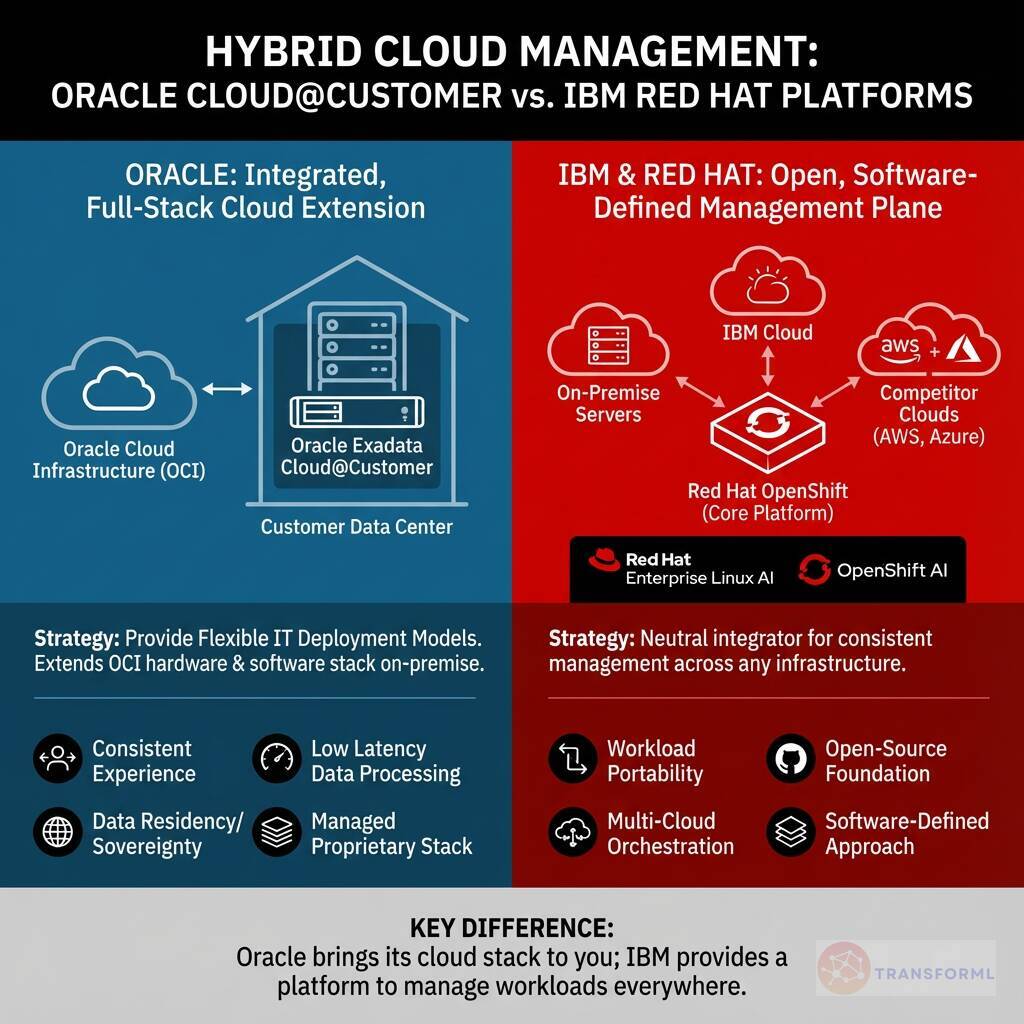
Oracle's approach to hybrid cloud is centered on extending its public cloud environment directly into a customer's data center. The strategy is to "Provide Flexible IT Deployment Models," with "Oracle Exadata Cloud@Customer" being the flagship offering. This solution involves placing Oracle's own hardware and software—the same stack that runs in Oracle Cloud Infrastructure (OCI)—on-premise. This provides a consistent experience for customers, allowing them to use cloud services like the Autonomous Database with minimal latency and while keeping data within their own facilities. Oracle's model is an integrated, hardware-and-software "full stack" approach, designed to deliver the performance and features of its public cloud in a private, managed environment.
IBM, in contrast, pursues a more open, software-defined strategy for hybrid cloud, with Red Hat OpenShift as its core platform. Rather than extending its own cloud hardware, IBM's goal is to be a neutral integrator, providing a consistent management layer that can run on any infrastructure—whether it's on-premise servers, IBM's cloud, or competitors' clouds like AWS and Azure. As stated in its strategy, IBM aims to "Enhance and promote Red Hat Enterprise Linux AI and OpenShift AI to provide clients with a consistent, open-source foundation for AI deployments." This positions IBM as a manager for complex, multi-cloud environments, focusing on orchestration and portability rather than a single, proprietary stack. The key difference is that Oracle brings its cloud to you, while IBM provides a platform to manage your workloads everywhere.
Review detailed strategy and competitive analysis of companies in Database Platforms
Source and Disclaimer: This article is based on analysis of Annual reports and other publicly available information. For informational purposes only (not investment, legal, or professional advice). Provided 'as is' without warranties. Trademarks and company names belong to their respective owners.