
Shopify's Strategy Analysis

Editor-reviewed by Ahmad Zaidi based on analysis by TransforML's proprietary AI
CEO, TransforML Platforms Inc. | Former Partner, McKinsey & Company
Strategy overview for Shopify
Shopify Inc.'s strategy is to provide the essential internet infrastructure for global commerce by offering an all-in-one, highly scalable operating system that empowers merchants to own their brand and customer relationships across multiple channels. The company’s main advantage is its merchant-first business model and rich third-party app ecosystem, which allows it to align its financial success directly with the sales growth of its users rather than aggregating buyers to a proprietary marketplace.
Its current priorities include expanding its international merchant base through localized pricing, capturing complex enterprise brands via Shopify Plus, integrating artificial intelligence tools to improve merchant productivity, and growing its suite of integrated financial solutions like Shopify Payments and Shopify Capital.
The biggest strategic question is whether the platform can successfully overcome intense competition from established software vendors as it moves upmarket into the enterprise segment, while simultaneously managing its exposure to macroeconomic downturns that disproportionately impact its core base of small and medium-sized businesses.
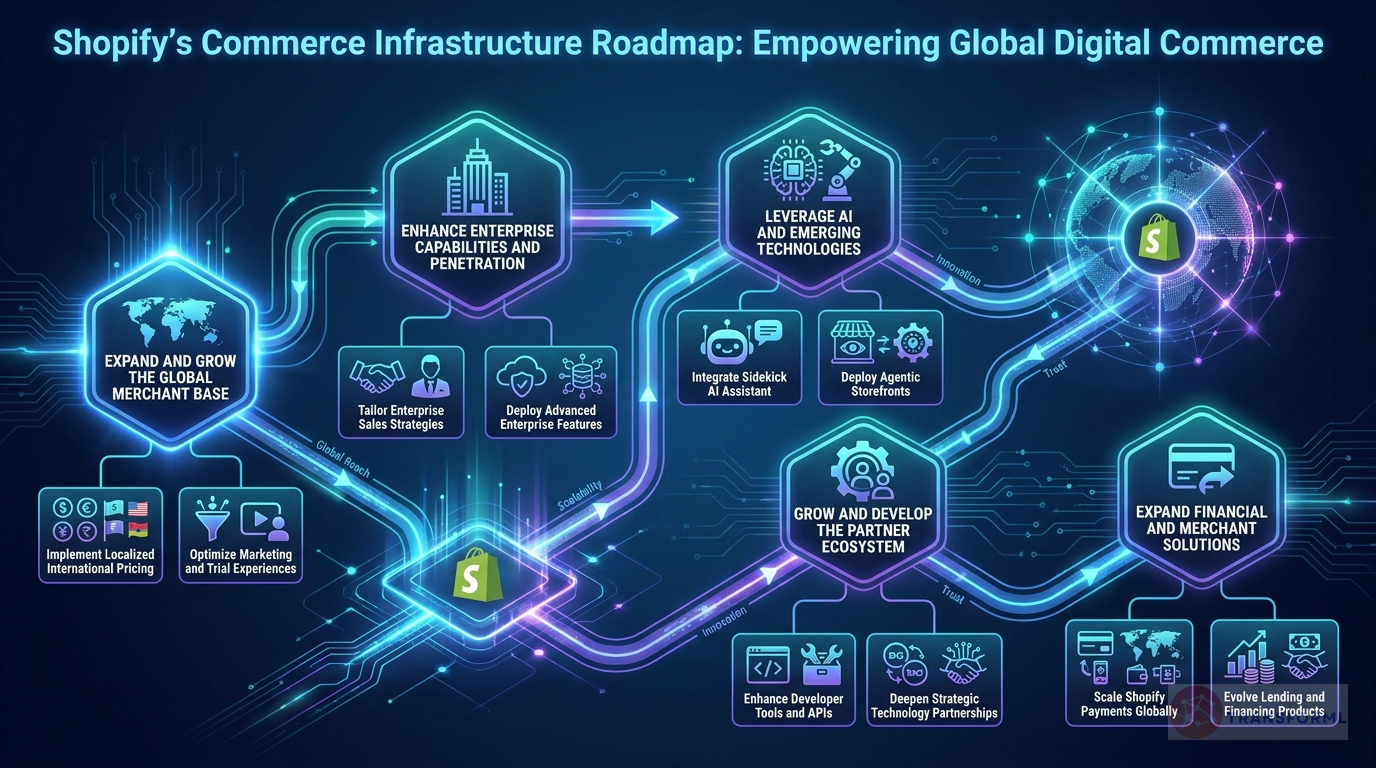
Shopify’s Strategy Visualized
Key Competitors for Shopify
Amazon
Massive consumer marketplace dominance, unparalleled proprietary fulfillment network, and immense brand recognition that aggregates buyer demand.
Salesforce Commerce Cloud
Deep integration with the broader Salesforce CRM ecosystem, strong enterprise B2B/B2C capabilities, and established relationships with large global brands.
BigCommerce
Open SaaS architecture, strong focus on API-driven headless commerce, and flexible enterprise-grade features tailored for complex catalogs.
WooCommerce
Deep integration with WordPress, open-source flexibility, and a massive installed base of content-driven websites.
Insights from Shopify's strategy and competitive advantages
What Stands Out in Shopify strategy and competitive advantage
Shopify's strategy is fundamentally distinctive from its marketplace-focused competitors because it operates as a merchant-first 'enabler' rather than a consumer-facing 'aggregator'. While competitors like Alibaba (Taobao/Tmall), MercadoLibre, and PDD (Pinduoduo/Temu) build massive destination marketplaces that own the customer traffic, Shopify provides the essential infrastructure for merchants to own their brand, data, and customer relationships across multiple channels. This is most evident in its 'How to Win' strategy, which focuses on empowering merchants through an all-in-one operating system, as opposed to MercadoLibre's strategy of creating an integrated ecosystem (Marketplace, Pago, Envios) that keeps users within its own flywheel.
Furthermore, Shopify's massive and open third-party app ecosystem (21,000+ apps) is a core part of its value proposition, allowing for unparalleled customization that is central to building a unique brand identity. This contrasts with competitors who, while having ecosystems, focus more on leveraging their scale for price competitiveness (PDD) or integrating proprietary services like logistics and cloud computing (Alibaba). Shopify's rapid deployment of democratized AI tools like 'Sidekick' and 'Agentic Storefronts' further distinguishes it by making enterprise-grade technology accessible to individual entrepreneurs, reinforcing its role as a technology provider rather than a retail destination.
What are the challenges facing Shopify to achieve their strategy and competitive advantage
Shopify's primary strategic challenge is its lack of a proprietary, end-to-end logistics network, which stands in stark contrast to its major global competitors. Both Alibaba (via Cainiao) and MercadoLibre (via Mercado Envios) have invested billions in building dominant logistics infrastructures, including dedicated aircraft, fulfillment centers, and last-mile delivery fleets. This gives them significant control over shipping costs, delivery speed, and the overall customer experience—a key competitive battleground. Shopify's reliance on third-party logistics partners creates a structural disadvantage in fulfillment, a critical component of e-commerce success.
Another significant challenge is the absence of a built-in demand generation engine. As an enabling platform, Shopify merchants are responsible for driving their own traffic, which can be costly and difficult. Competitors like MercadoLibre, PDD, and Alibaba are massive consumer destinations that organically attract millions of shoppers (e.g., MercadoLibre has 84 million unique active buyers), directly funneling demand to their sellers. This makes Shopify's growth highly dependent on the marketing acumen of its SMB merchant base, which is also more vulnerable to macroeconomic downturns and intense price competition from low-cost marketplaces like PDD's Temu.
What Positions Shopify to win
Financial Strengths
-
Shopify demonstrated exceptional financial performance in 2025, generating $11.6 billion in total revenue (30% YoY growth) and $2.03 billion in operating cash flow, providing massive capital for reinvestment.
Market Scale and Reach
-
The platform facilitated $378.4 billion in Gross Merchandise Volume (GMV) in 2025, representing a 29% YoY increase and highlighting the massive scale and success of its merchant base.
Strategic Ecosystem
-
Shopify boasts a rich ecosystem with over 21,000 apps available in the Shopify App Store, creating a powerful network effect that makes the platform highly sticky and customizable.
Innovation and AI Capabilities
-
The company is at the forefront of commerce AI, integrating advanced features like Sidekick (an AI commerce assistant) and Agentic Storefronts to drive merchant productivity and buyer discovery.
Integrated Financial Solutions
-
Shopify Payments achieved a 65.6% penetration rate in 2025, facilitating $248.1 billion in GMV and driving the company's highly lucrative merchant solutions revenue segment.
Operational Infrastructure
-
The platform utilizes a multi-tenant, single-branch cloud architecture that ensures all merchants are on the latest version, allowing for rapid deployment of updates and high reliability during traffic spikes.
Lifecycle Product Strategy
-
Shopify successfully caters to the entire business lifecycle, capturing early-stage entrepreneurs with basic plans and scaling them into enterprise-grade Shopify Plus merchants.
Human Capital and Culture
-
The company maintains a strong remote-first, global workforce of approximately 7,600 employees, supported by the 'Mastery' craft-first talent system to drive continuous innovation.
What's the winning aspiration for Shopify strategy
To provide essential internet infrastructure for commerce with a platform and services engineered for speed, customization, reliability, and security, while delivering a better shopping experience for consumers everywhere.
Company Vision Statement:
Make commerce better for everyone.
Where Shopify Plays Strategically
Shopify competes in the global digital and omnichannel commerce infrastructure market, serving businesses of all sizes across multiple retail verticals.
Key Strategic Areas:
How Shopify tries to Win Strategically
Shopify wins by providing an all-in-one, highly scalable commerce operating system that empowers merchants to own their brand while benefiting from enterprise-grade technology, a massive app ecosystem, and integrated financial services.
Key Competitive Advantages:
Strategy Cascade for Shopify
Below is a strategy cascade for Shopify's strategy that has been formed through an outside-in analysis of publicly available data. Scroll down below the graphic to click on the arrows to expand each strategic pillar and see more details:
Expand and Grow the Global Merchant Base
Continuously improve the ease with which merchants can get a new or existing business up and running, while expanding the global footprint across new geographic regions.
Implement Localized International Pricing
Offer localized pricing plans and local currency billing in select countries to attract international merchants and reduce friction in new markets.
Optimize Marketing and Trial Experiences
Inspire entrepreneurship through targeted marketing programs and optimized paid trial experiences to drive top-of-funnel merchant acquisition.
Enhance Enterprise Capabilities and Penetration
Solve for the complexity of growing merchants by offering advanced functionality, scalability, and support through Shopify Plus and enterprise-level offerings.
Tailor Enterprise Sales Strategies
Tailor sales strategies and onboarding cycles specifically to attract large volume brands and complex B2B operations.
Deploy Advanced Enterprise Features
Develop and deploy advanced features like Shopify Audiences for customer acquisition and Launchpad for ecommerce automation.
Leverage AI and Emerging Technologies
Invest heavily in data analytics, machine learning, and artificial intelligence to increase merchant productivity, improve workflows, and enhance product reach.
Integrate Sidekick AI Assistant
Integrate Sidekick, Shopify's AI-enabled commerce assistant, across the platform to help merchants make smarter decisions.
Deploy Agentic Storefronts
Enable agent-assisted product discovery and checkout across various AI platforms through the deployment of Agentic Storefronts.
Grow and Develop the Partner Ecosystem
Cultivate a rich ecosystem of app developers, theme designers, and strategic partners to extend the functionality and flexibility of the Shopify platform.
Enhance Developer Tools and APIs
Provide robust tools and APIs to make it easier for ecosystem partners to build and publish applications, expanding the 21,000+ apps currently available.
Deepen Strategic Technology Partnerships
Form and deepen strategic partnerships with third-party technology, fulfillment, and AI providers to generate incremental revenue opportunities.
Expand Financial and Merchant Solutions
Augment subscription solutions by expanding integrated merchant solutions like Shopify Payments, Shopify Capital, and Shopify Balance to drive additional value.
Scale Shopify Payments Globally
Increase the penetration rate of Shopify Payments globally, which facilitated $248.1 billion in GMV in 2025.
Evolve Lending and Financing Products
Explore new products, models, and funding options for Shopify Capital and Shopify Credit to provide essential working capital to merchants.
Source and Disclaimer: This analysis is based on analysis of Annual reports and other publicly available information. For informational purposes only (not investment, legal, or professional advice). Provided 'as is' without warranties. Trademarks and company names belong to their respective owners.