

Editor-reviewed by Ahmad Zaidi based on analysis by TransforML's proprietary AI
CEO, TransforML Platforms Inc. | Former Partner, McKinsey & Company
How are Disney, Amazon, and Comcast using service bundles to challenge Netflix's standalone streaming model?
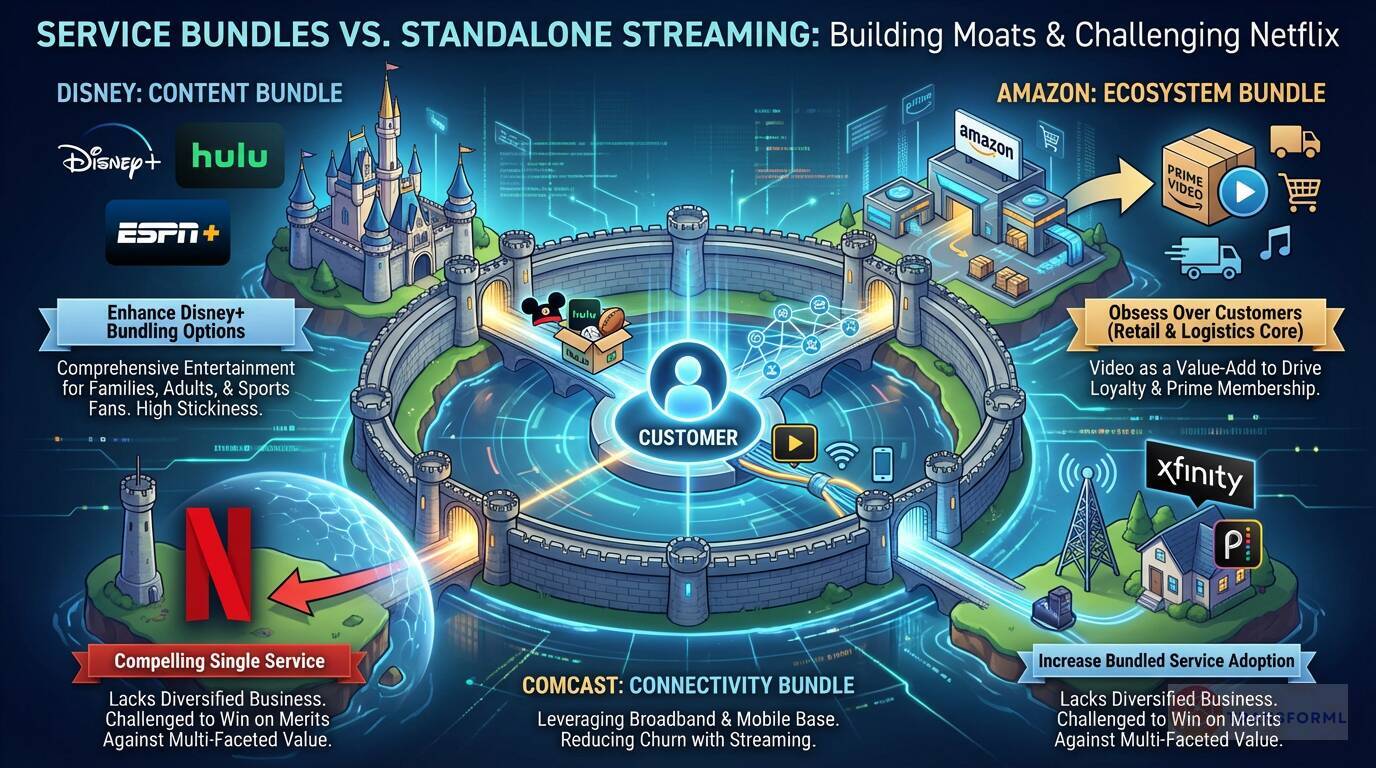
Disney, Amazon, and Comcast are all using service bundles to create "moats" around their customers, presenting a significant challenge to Netflix's pure-play, standalone model. Each company's bundle is unique and leverages its core business strengths. Disney employs a content bundle with its goal to "Enhance Disney+ Bundling Options," packaging Disney+, Hulu, and ESPN+ together. This creates a comprehensive and sticky entertainment offering that caters to families (Disney+), adults (Hulu), and sports fans (ESPN+), making the combined value proposition difficult for households to abandon.
Amazon and Comcast use bundling to integrate streaming into a much broader ecosystem. For Amazon, Prime Video is a key feature of its Prime membership, which is fundamentally a retail and logistics program designed to "Obsess Over Customers" with benefits like fast shipping. Video is a powerful value-add to drive loyalty to its core e-commerce business. Comcast uses a connectivity bundle, focusing on its strategy to "Increase Bundled Service Adoption" by packaging its Peacock service with Xfinity broadband and mobile plans. This leverages its massive base of internet customers, using streaming as a tool to increase the value of its primary services and reduce churn. For Netflix, which lacks a comparable diversified business, the challenge is to make its single service so compelling that it can win on its own merits against these multi-faceted value propositions.
Review detailed strategy and competitive analysis of companies in Streaming-Video Services
Source and Disclaimer: This article is based on analysis of Annual reports and other publicly available information. For informational purposes only (not investment, legal, or professional advice). Provided 'as is' without warranties. Trademarks and company names belong to their respective owners.