
What strategies are companies in Streaming-Video Services using to win
Explore Streaming-Video Services company strategies

Editor-reviewed by Ahmad Zaidi based on analysis by TransforML's proprietary AI
CEO, TransforML Platforms Inc. | Former Partner, McKinsey & Company
In Streaming-Video Services, the following strategies are implemented by companies to win:
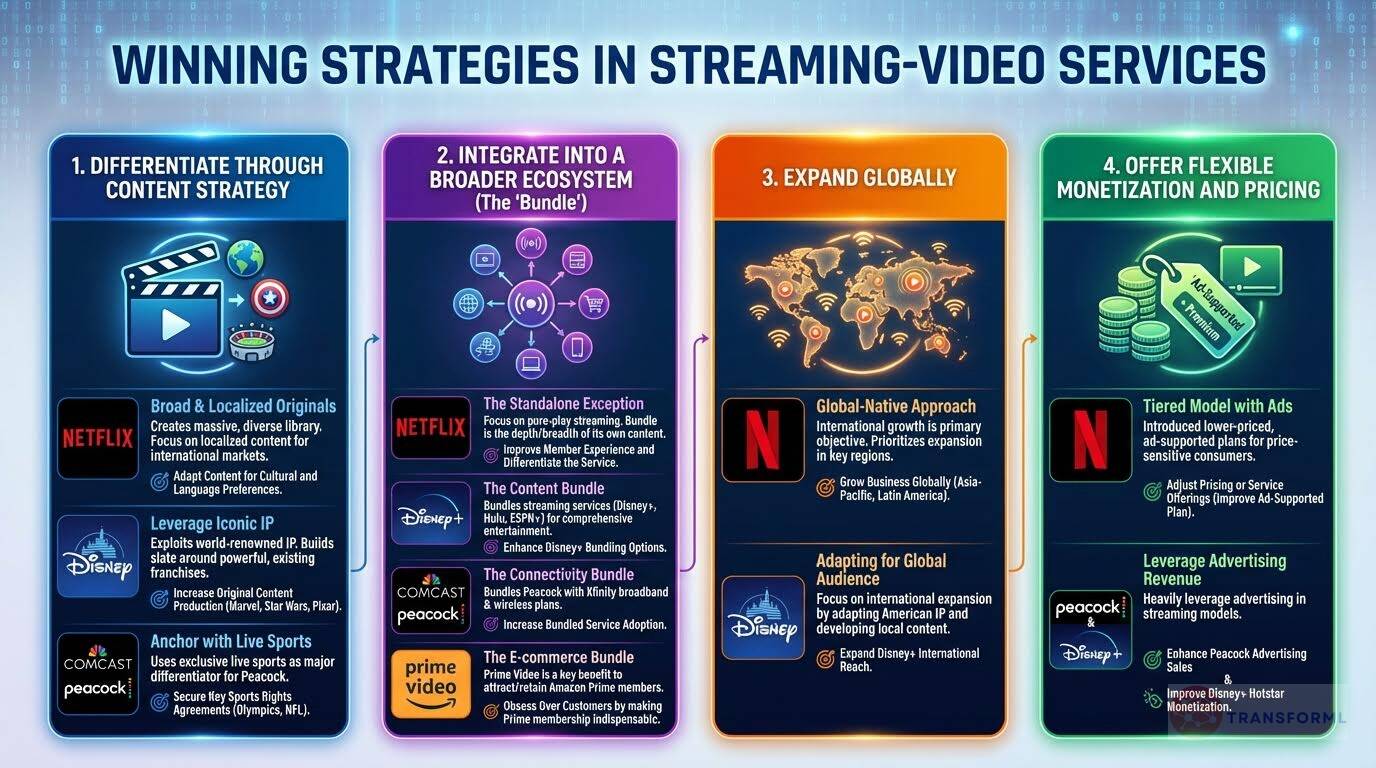
1. Differentiate Through Content Strategy
Content is the primary driver for attracting and retaining subscribers, but the winning approach varies.
Example: Broad & Localized Originals (Netflix): Netflix's strategy is to create a massive and diverse library of original content, with a strong emphasis on producing content tailored to specific international markets.
Example: Example: Netflix's goal to "Adapt Content for Cultural and Language Preferences" drives its global growth by investing in local productions that appeal to regional tastes.
Example: Leverage Iconic IP (Disney): Disney's strategy is to exploit its world-renowned intellectual property across its services. It builds its content slate around powerful, pre-existing franchises.
Example: Example: Disney focuses on "Increase Original Content Production" for key franchises like Marvel, Star Wars, and Pixar, creating a powerful draw for its streaming platforms.
Example: Anchor with Live Sports (Comcast): Comcast uses exclusive live sports as a major differentiator for its Peacock service to attract a dedicated audience.
Example: Example: A key initiative for Comcast is to "Secure Key Sports Rights Agreements" for events like the Olympics and NFL, making Peacock a must-have for sports fans.
2. Integrate into a Broader Ecosystem (The "Bundle")
For most competitors, the streaming service is not a standalone product but a key piece of a larger value proposition.
Example: The Standalone Exception (Netflix): Netflix is unique in its focus on a pure-play streaming model. Its "bundle" is the depth and breadth of its own content library. Its primary challenge is competing against the ecosystem bundles of its rivals.
Example: Example: Netflix aims to "Improve Member Experience" and "Differentiate the Service" based solely on the merit of its platform, without relying on other business lines.
Example: The Content Bundle (Disney): Disney bundles its streaming services (Disney+, Hulu, ESPN+) to offer a comprehensive entertainment package and reduce churn.
Example: Example: Disney's strategy includes a goal to "Enhance Disney+ Bundling Options," creating a sticky ecosystem of its own media properties.
Example: The Connectivity Bundle (Comcast): Comcast leverages its core business as an internet and mobile provider by bundling Peacock with those services.
Example: Example: Comcast actively seeks to "Increase Bundled Service Adoption" by packaging its Peacock service with its Xfinity broadband and wireless plans.
Example: The E-commerce Bundle (Amazon): Amazon uses Prime Video as a key benefit to attract and retain Amazon Prime members, driving loyalty and spending in its core retail business.
Example: Example: Prime Video is not a separate profit center but a crucial part of Amazon's overarching goal to "Obsess Over Customers" by making the Prime membership indispensable.
3. Expand Globally
Reaching a global audience is critical for scaling the business and amortizing high content production costs.
Example: Netflix: As a "global-native" company, international growth is a primary objective.
Example: Example: Netflix's top-level goal is to "Grow Business Globally" by prioritizing expansion in regions like Asia-Pacific and Latin America.
Example: Disney: Is also focused on international expansion but often does so by adapting its primarily American-originated IP for a global audience.
Example: Example: Disney aims to "Expand Disney+ International Reach" by launching in new markets and developing some local content.
4. Offer Flexible Monetization and Pricing
The "one-price-fits-all" model has been replaced by a tiered approach to capture a wider range of customers.
Example: Netflix: Has introduced lower-priced, ad-supported plans to attract price-sensitive consumers.
Example: Example: A key Netflix initiative is to "Adjust Pricing or Service Offerings" by improving its ad-supported plan.
Example: Comcast & Disney: Also heavily leverage advertising revenue in their streaming models.
Example: Example: Comcast focuses on "Enhance Peacock Advertising Sales," while Disney works to "Improve Disney+ Hotstar Monetization" through both advertising and pricing.
Read More
Review detailed strategy and competitive analysis of companies in Streaming-Video Services
Source and Disclaimer: This analysis is based on analysis of Annual reports and other publicly available information. For informational purposes only (not investment, legal, or professional advice). Provided 'as is' without warranties. Trademarks and company names belong to their respective owners.