

Editor-reviewed by Ahmad Zaidi based on analysis by TransforML's proprietary AI
CEO, TransforML Platforms Inc. | Former Partner, McKinsey & Company
Platform vs. Platform: How do the consolidation strategies of Palantir's 'Operating System,' Palo Alto Networks, and CrowdStrike compare?
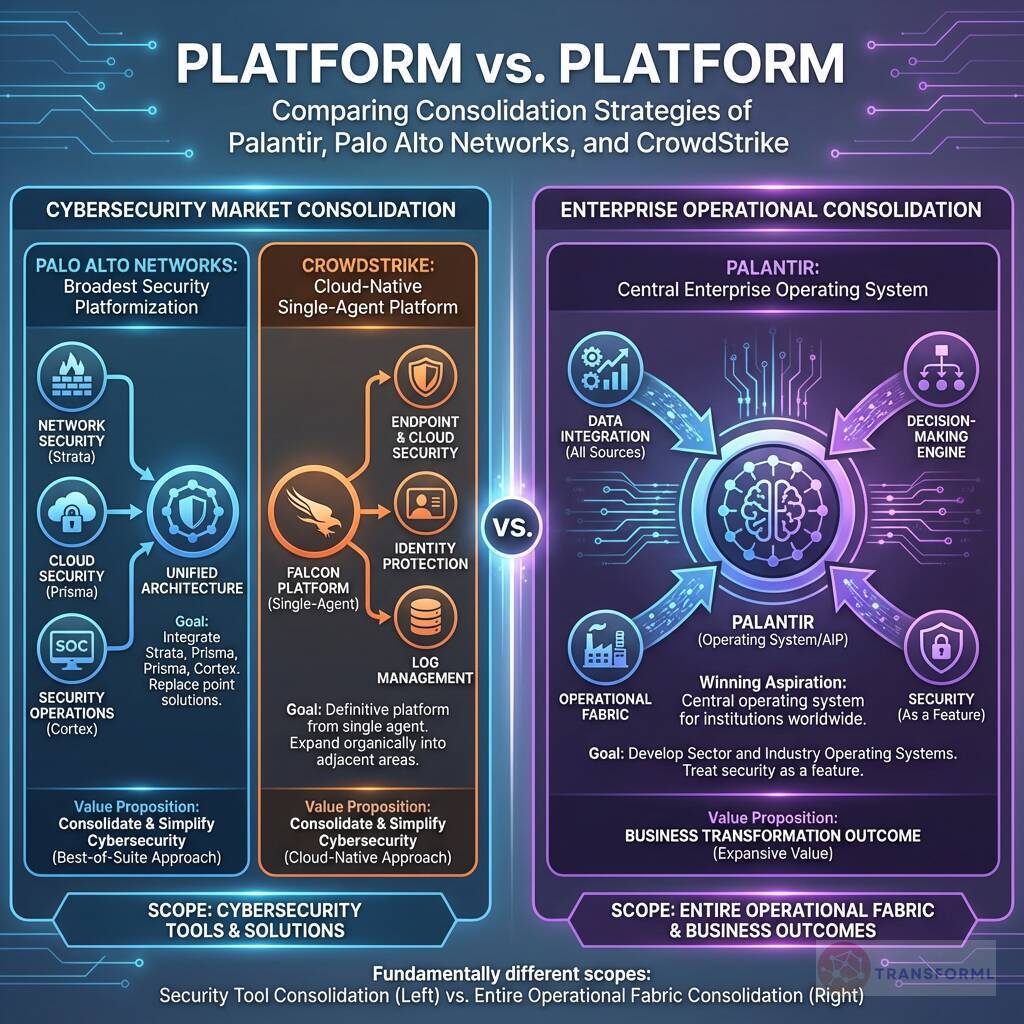
The "platform consolidation" strategy differs dramatically in scope and ambition across these three companies. Palo Alto Networks and CrowdStrike are fighting to consolidate the cybersecurity market. Palo Alto Networks' "Platformization" strategy is the broadest in security, aiming to integrate its three core pillars—Network Security (Strata), Cloud Security (Prisma), and Security Operations (Cortex)—into one unified architecture. This "best-of-suite" approach is designed to replace dozens of point solutions. CrowdStrike also aims to be the "definitive platform for cybersecurity consolidation," but its approach is built from its "cloud-native," "single-agent" Falcon platform, expanding organically from endpoint and cloud security into adjacent areas like identity protection and log management.
Palantir's strategy is in a different league. It is not consolidating cybersecurity tools but rather aiming to consolidate an organization's entire operational fabric. Its winning aspiration is to be the "central operating system for institutions worldwide." This is evident in its goal to "Develop Sector and Industry Operating Systems," which treats security as a feature within a much larger data integration and decision-making engine. While Palo Alto and CrowdStrike sell a security outcome, Palantir sells a business transformation outcome, which is a fundamentally different and more expansive value proposition.
Review detailed strategy and competitive analysis of companies in Cybersecurity & Data Analytics
Source and Disclaimer: This article is based on analysis of Annual reports and other publicly available information. For informational purposes only (not investment, legal, or professional advice). Provided 'as is' without warranties. Trademarks and company names belong to their respective owners.