

Editor-reviewed by Ahmad Zaidi based on analysis by TransforML's proprietary AI
CEO, TransforML Platforms Inc. | Former Partner, McKinsey & Company
What is the Future of Sustainable Aviation: Comparing GE Aerospace's Open Fan Engine vs. RTX's Next-Generation Propulsion?
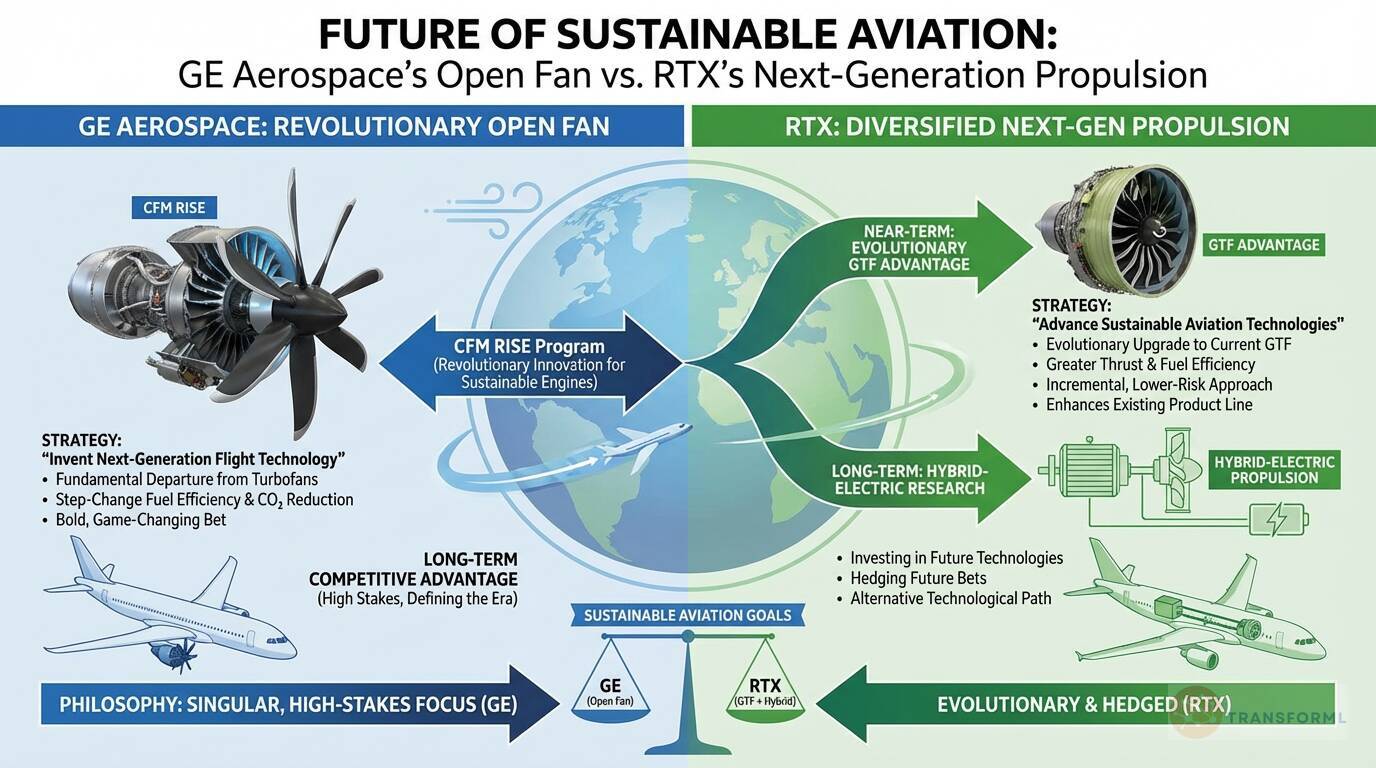
GE Aerospace is making a bold, revolutionary bet on its CFM RISE (Revolutionary Innovation for Sustainable Engines) program. This initiative, part of its "Invent Next-Generation Flight Technology" strategy, is centered on developing an Open Fan engine architecture. This design is a fundamental departure from traditional turbofans and aims to deliver a significant step-change in fuel efficiency and CO2 emissions. By focusing R&D on this potentially game-changing technology, GE is positioning itself to define the next era of commercial flight, aiming to secure a long-term competitive advantage if the architecture proves successful and is adopted by airframers.
In contrast, RTX is pursuing a more diversified, dual-track strategy to "Advance Sustainable Aviation Technologies." Its immediate focus is on delivering the GTF Advantage engine, an evolutionary upgrade to its current Geared Turbofan technology that offers "greater thrust and better fuel efficiency." This is an incremental, lower-risk approach that enhances its existing successful product line. Simultaneously, RTX is investing in longer-term research into "hybrid-electric propulsion systems." This allows RTX to compete in the near term with an improved current-generation product while hedging its future bets on a different technological path, contrasting with GE's singular, high-stakes focus on the Open Fan.
Review detailed strategy and competitive analysis of companies in Aerospace & Defense Contractors
Source and Disclaimer: This article is based on analysis of Annual reports and other publicly available information. For informational purposes only (not investment, legal, or professional advice). Provided 'as is' without warranties. Trademarks and company names belong to their respective owners.