
What strategies are companies in Aerospace & Defense Contractors using to win
Explore Aerospace & Defense Contractors company strategies

Editor-reviewed by Ahmad Zaidi based on analysis by TransforML's proprietary AI
CEO, TransforML Platforms Inc. | Former Partner, McKinsey & Company
In Aerospace & Defense Contractors, the following strategies are implemented by companies to win:
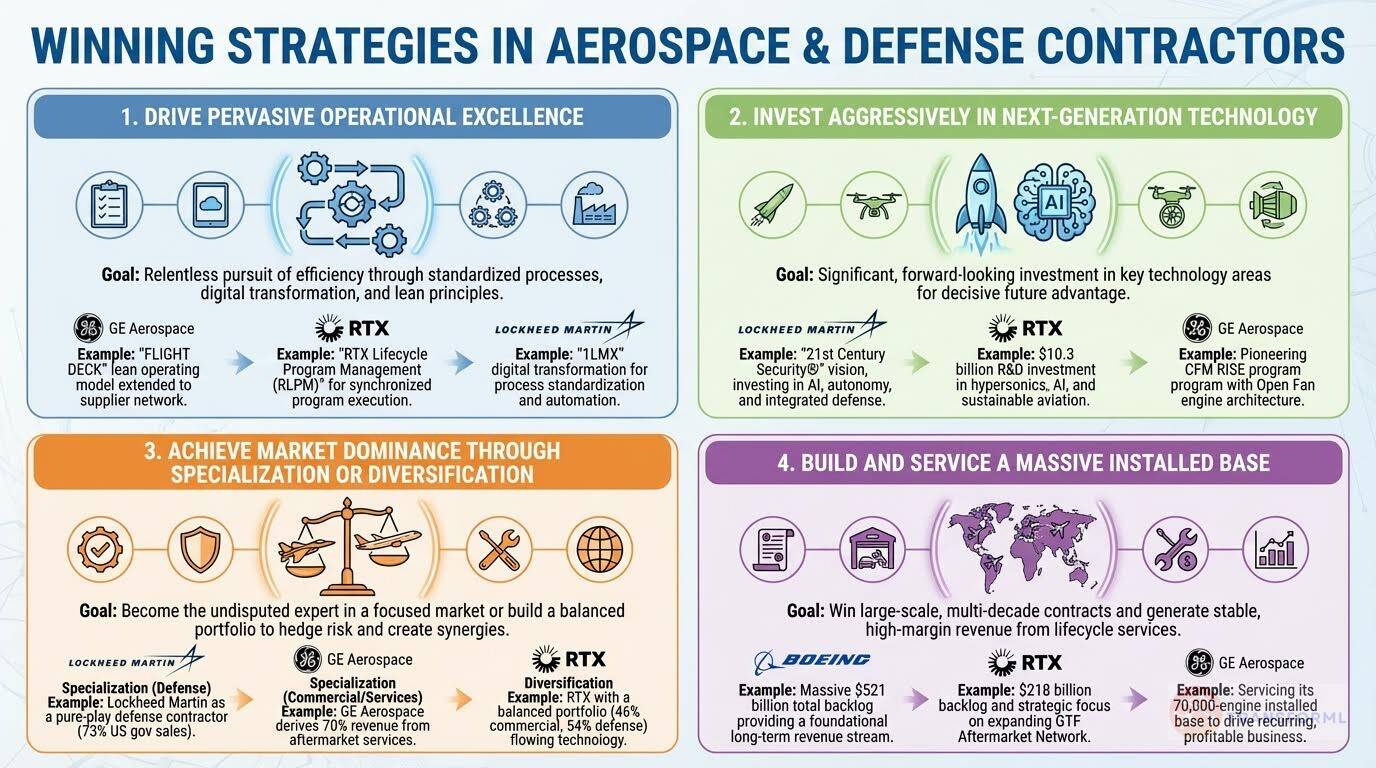
1. Drive Pervasive Operational Excellence
A fundamental strategy is the relentless pursuit of efficiency through standardized processes, digital transformation, and lean principles. This reduces costs, improves quality, and accelerates delivery.
Example: GE Aerospace has branded this concept as its core advantage with "FLIGHT DECK," a proprietary lean operating model used to translate strategy into outcomes. It even aims to "Extend FLIGHT DECK to Supplier Network."
Example: RTX employs its "RTX Lifecycle Program Management (RLPM)" framework to synchronize knowledge and improve program execution across its diverse business units.
Example: Lockheed Martin uses its "1LMX" digital transformation initiative to standardize processes and deploy automation and robotics to increase efficiency on programs like HIMARS.
2. Invest Aggressively in Next-Generation Technology
Winning requires significant, forward-looking investment in a few key technology areas to create a decisive advantage for the next decade.
Example: Lockheed Martin is all-in on its "21st Century Security®" vision, investing heavily in AI, autonomy, and crewed/uncrewed teaming to create an integrated defense network.
Example: RTX's "Innovating for future growth" pillar is backed by a $10.3 billion investment in R&D and capital expenditures, targeting advancements in hypersonics, AI, and sustainable aviation.
Example: GE Aerospace is focused on defining the future of commercial propulsion. Its primary technology bet is the CFM RISE program, which pioneers a revolutionary Open Fan engine architecture for greater fuel efficiency.
3. Achieve Market Dominance through Specialization or Diversification
Companies succeed by either becoming the undisputed expert in a focused market or by building a balanced portfolio that hedges against risk and creates unique cross-divisional synergies.
Example: Specialization (Defense): Lockheed Martin is a pure-play defense contractor, with 73% of sales from the U.S. government. This focus allows it to build deep customer intimacy and a highly tailored strategy.
Example: Specialization (Commercial/Services): GE Aerospace derives approximately 70% of its revenue from high-margin aftermarket services. Its strategy is almost entirely built around servicing its massive installed engine base.
Example: Diversification: RTX stands out with its balanced portfolio (46% commercial, 54% defense). Its strategy explicitly focuses on "Leveraging our breadth and scale" to flow technology and talent between its defense (Raytheon) and commercial (Pratt & Whitney, Collins) businesses.
4. Build and Service a Massive Installed Base
Long-term success is secured by winning large-scale, multi-decade contracts that create enormous backlogs and then generating stable, high-margin revenue from servicing that equipment for its entire lifecycle.
Example: Boeing, despite its operational challenges, has a massive total backlog of $521 billion, which provides a foundational, long-term revenue stream no competitor can easily replicate.
Example: RTX holds a $218 billion backlog and is strategically focused on capturing future revenue by actively working to "Expand GTF Aftermarket Network."
Example: GE Aerospace has built its business model on this, using its 70,000-engine installed base to drive a recurring, profitable services business. Its goal is to "Focus on service and readiness" by increasing MRO capacity.
Read More
Review detailed strategy and competitive analysis of companies in Aerospace & Defense Contractors
Source and Disclaimer: This analysis is based on analysis of Annual reports and other publicly available information. For informational purposes only (not investment, legal, or professional advice). Provided 'as is' without warranties. Trademarks and company names belong to their respective owners.