

Editor-reviewed by Ahmad Zaidi based on analysis by TransforML's proprietary AI
CEO, TransforML Platforms Inc. | Former Partner, McKinsey & Company
How are semiconductor leaders like Analog Devices and Texas Instruments enabling the rise of the digitized factory (Industry 4.0)?
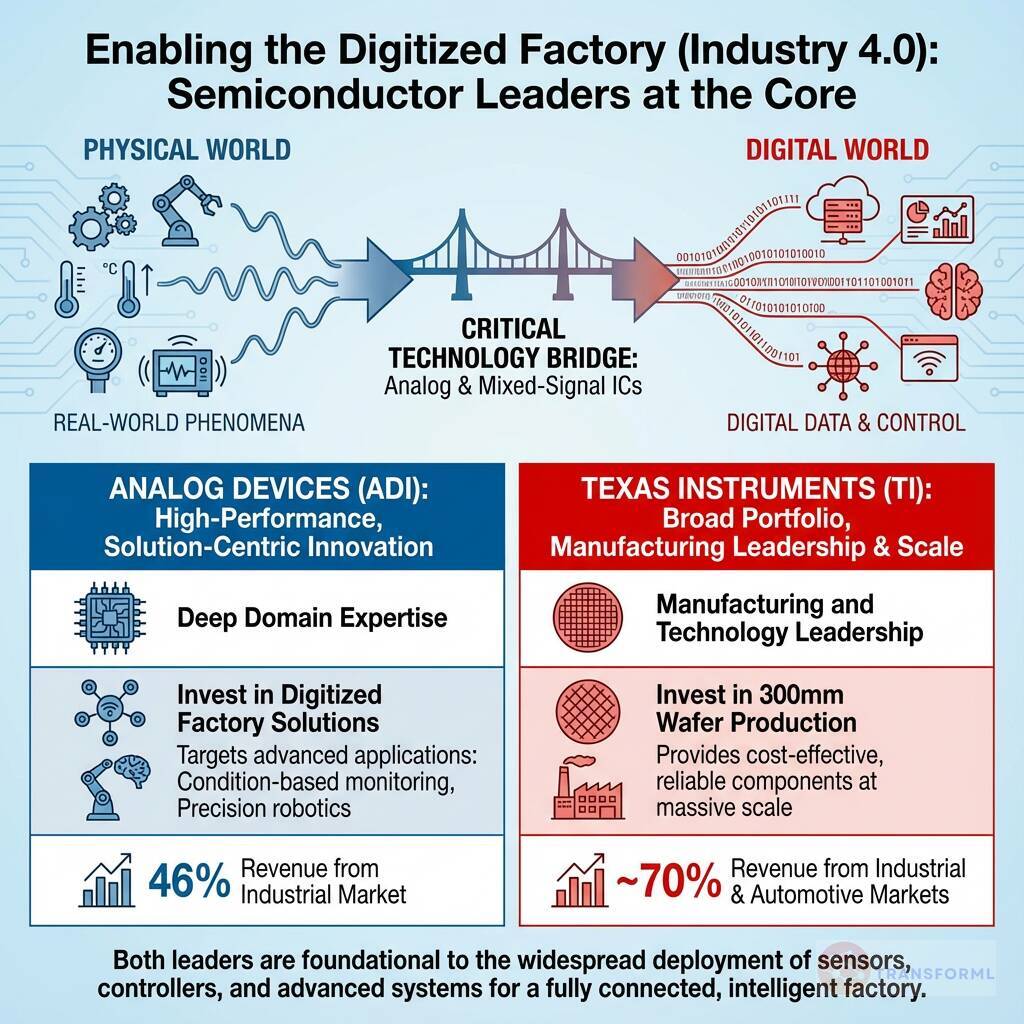
Semiconductor leaders are the foundational enablers of the digitized factory, or Industry 4.0, by providing the critical technology that bridges the physical world of manufacturing with the digital world of data and analytics. Their analog and mixed-signal integrated circuits (ICs) are essential for sensing, measuring, and interpreting real-world phenomena like temperature, pressure, and vibration. This data is then converted into a digital format for processing, analysis, and control. Both Analog Devices (ADI) and Texas Instruments (TI) have identified the industrial market as a primary area for growth, with the sector representing 46% of ADI's revenue and being a core focus for TI, which earns about 70% of its revenue from the industrial and automotive markets combined.
Analog Devices and Texas Instruments employ distinct strategies to empower Industry 4.0. ADI focuses on high-performance, solution-centric innovation, positioning itself to solve the most complex challenges in factory automation. Its goal to "Invest in Digitized Factory Solutions" targets advanced applications like condition-based monitoring and precision robotics, which rely on its "Deep Domain Expertise" in high-fidelity signal processing. In contrast, Texas Instruments leverages its "Manufacturing and Technology" leadership and broad product portfolio. By heavily investing in "300mm Wafer Production," TI aims to provide cost-effective, reliable components at a massive scale, which is crucial for the widespread deployment of sensors and controllers across an entire factory floor, as reflected in its goal to "Expand Industrial Automation Offerings."
Review detailed strategy and competitive analysis of companies in Analog & Mixed-Signal ICs
Source and Disclaimer: This article is based on analysis of Annual reports and other publicly available information. For informational purposes only (not investment, legal, or professional advice). Provided 'as is' without warranties. Trademarks and company names belong to their respective owners.