
What strategies are companies in GPU & High-Performance Compute Chips using to win
Explore GPU & High-Performance Compute Chips company strategies

Editor-reviewed by Ahmad Zaidi based on analysis by TransforML's proprietary AI
CEO, TransforML Platforms Inc. | Former Partner, McKinsey & Company
In GPU & High-Performance Compute Chips, the following strategies are implemented by companies to win:
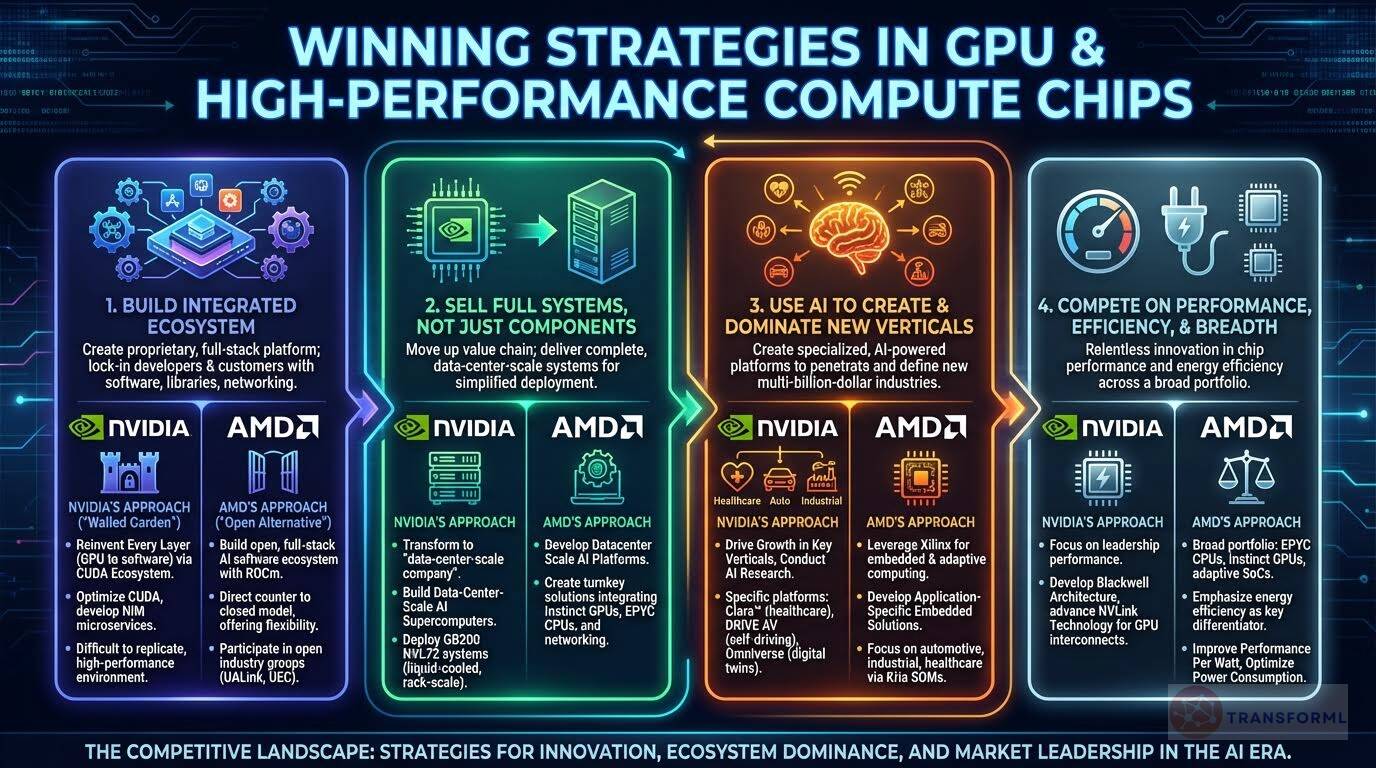
1. Build a Comprehensive and Integrated Ecosystem
A dominant strategy is to create a proprietary, full-stack platform that locks in developers and customers. This goes beyond selling hardware to providing the software, libraries, and networking that make the hardware useful.
Example: NVIDIA's Approach (The "Walled Garden"): NVIDIA exemplifies this with its CUDA Ecosystem. Their strategy is to "Reinvent Every Layer of Computing" from the GPU to the software. They reinforce this with goals to "Optimize CUDA Software Ecosystem" and develop services like "NVIDIA Inference Microservices (NIM)" to create a sticky, high-performance environment that is difficult for competitors to replicate.
Example: AMD's Approach (The "Open Alternative"): As a challenger, AMD's strategy is to "Build [an] open, full-stack AI software ecosystem" with ROCm. This is a direct counter to NVIDIA's closed model, aiming to attract customers who want flexibility and to avoid vendor lock-in. They support this by participating in open industry groups like "UALink and UEC."
2. Sell Full Systems, Not Just Components
A key shift is moving up the value chain from selling individual chips to delivering complete, data-center-scale systems. This simplifies deployment for customers and captures more value.
Example: NVIDIA's Approach: NVIDIA is transforming into a "data-center-scale company" with the goal to "Build Data-Center-Scale AI Supercomputers." A prime example is their plan to deploy "GB200 NVL72 systems," which are entire liquid-cooled, rack-scale systems marketed as a single, powerful GPU.
Example: AMD's Approach: AMD is also pursuing this with its goal to "Develop Datacenter Scale AI Platforms." Their strategy involves creating turnkey solutions that integrate their "AMD Instinct accelerators with EPYC processors and networking solutions."
3. Use AI to Create and Dominate New Vertical Markets
Leading companies aren't just selling general-purpose chips; they are creating specialized, AI-powered platforms to penetrate and define new multi-billion-dollar industries.
Example: NVIDIA's Approach: NVIDIA's strategy is to "Drive Growth in Key Verticals" and "Conduct AI Research and Create New Markets." They execute this by building specific platforms like NVIDIA Clara™ for healthcare, DRIVE AV for self-driving cars, and Omniverse for industrial digital twins.
Example: AMD's Approach: AMD leverages its acquisition of Xilinx to pursue this with "embedded and adaptive computing solutions." They aim to "Develop Application-Specific Embedded Solutions" for markets like automotive, industrial, and healthcare, using products like their Kria System on Modules.
4. Compete on Performance, Efficiency, and Breadth
At the core, relentless innovation in chip performance and energy efficiency is crucial. Winning involves offering a broad portfolio that can address diverse workloads from the data center to client devices.
Example: NVIDIA's Approach: NVIDIA focuses on leadership performance with initiatives like the "Develop Blackwell Architecture" and advancing its "NVLink Technology" for GPU interconnects.
Example: AMD's Approach: AMD competes by offering a broad portfolio of high-performance CPUs (EPYC), GPUs (Instinct), and adaptive SoCs. They emphasize energy efficiency as a key differentiator, with goals to "Improve Performance Per Watt" and "Optimize Power Consumption Across Product Lines."
Read More
Review detailed strategy and competitive analysis of companies in GPU & High-Performance Compute Chips
Source and Disclaimer: This analysis is based on analysis of Annual reports and other publicly available information. For informational purposes only (not investment, legal, or professional advice). Provided 'as is' without warranties. Trademarks and company names belong to their respective owners.