
What strategies are companies in Semiconductor-Equipment Makers using to win
Explore Semiconductor-Equipment Makers company strategies

Editor-reviewed by Ahmad Zaidi based on analysis by TransforML's proprietary AI
CEO, TransforML Platforms Inc. | Former Partner, McKinsey & Company
In Semiconductor-Equipment Makers, the following strategies are implemented by companies to win:
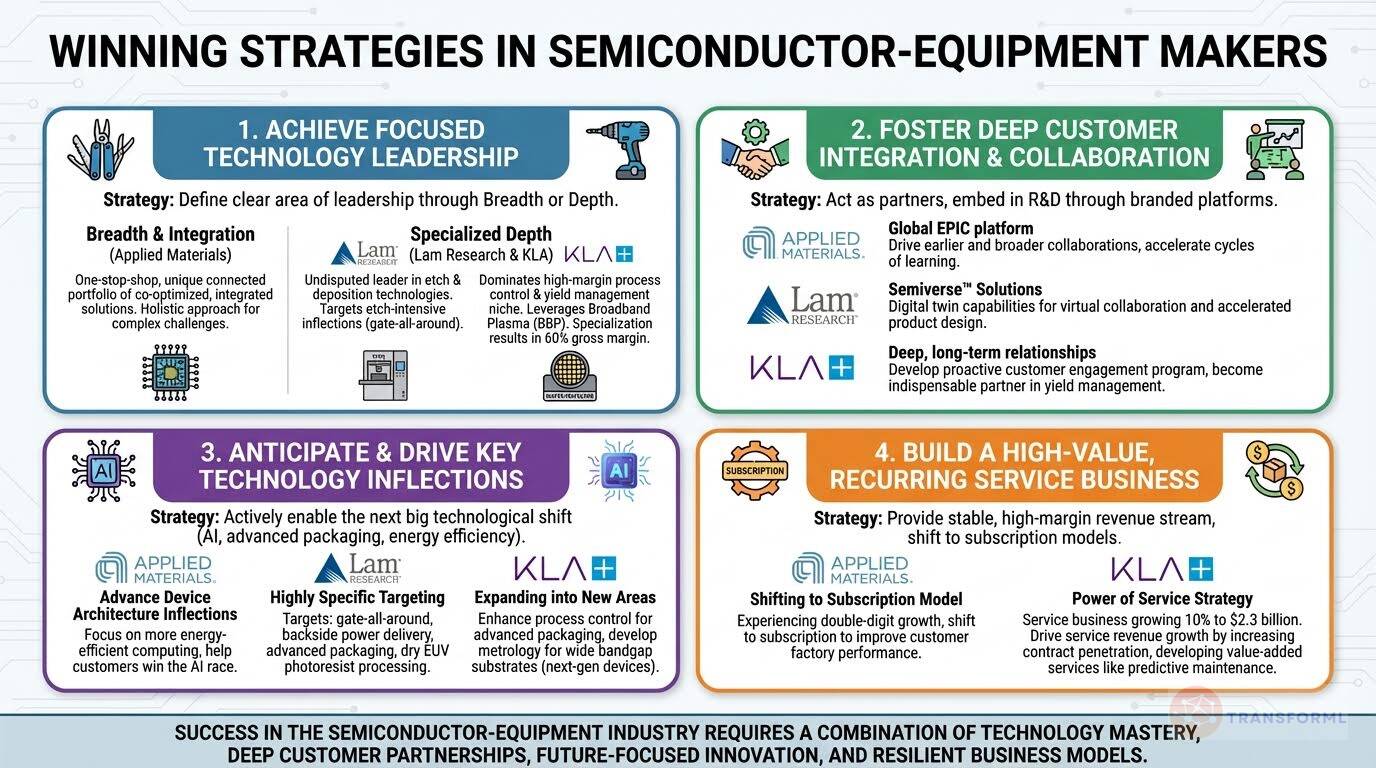
1. Achieve Focused Technology Leadership
Success isn't just about having good technology, but about defining a clear area of leadership. Companies do this in one of two ways: breadth or depth.
Example: Breadth & Integration (Applied Materials): AMAT's strategy is to be a one-stop-shop, building a "unique and connected portfolio" of "co-optimized, integrated solutions." This allows them to tackle complex challenges like heterogeneous integration holistically.
Example: Specialized Depth (Lam Research & KLA): In contrast, competitors focus on being the undisputed best in a specific domain.
Example: Lam Research has "clear leadership in the etch and deposition technologies" and explicitly targets capitalizing on "etch- and deposition-intensive technology inflections like gate-all-around."
Example: KLA dominates the high-margin niche of process control and yield management, leveraging its "Broadband Plasma (BBP) optical patterned wafer inspectors." This specialization results in a 60% gross margin, significantly higher than AMAT's 47.5%.
2. Foster Deep Customer Integration and Collaboration
Winning companies act as partners, not just vendors. They embed themselves in their customers' R&D processes, often through branded platforms that go beyond standard support.
Example: Applied Materials uses its "global EPIC platform" to drive "earlier and broader collaborations" and accelerate cycles of learning.
Example: Lam Research uses its "Semiverse™ Solutions," which includes "digital twin capabilities," to enable virtual collaboration and accelerate product design in simulated environments.
Example: KLA focuses on building "deep, long-term relationships" and developing a "proactive customer engagement program" to become an indispensable partner in yield management.
3. Anticipate and Drive Key Technology Inflections
Leaders don't just respond to change; they actively enable the next big technological shift, particularly around AI, advanced packaging, and energy efficiency.
Example: Applied Materials focuses on enabling "more energy-efficient computing" and aims to "Advance Device Architecture Inflections" to help customers win the AI race.
Example: Lam Research is highly specific, targeting inflections like "gate-all-around, backside power delivery, advanced packaging, and dry extreme ultraviolet photoresist processing."
Example: KLA is also expanding into these areas by enhancing "process control solutions for advanced packaging" and developing "metrology capabilities for wide bandgap substrates" used in next-gen devices.
4. Build a High-Value, Recurring Service Business
A strong service business provides a stable, high-margin revenue stream and increases customer loyalty. The most advanced strategies are shifting from transactional services to subscription models.
Example: Applied Materials is experiencing "double-digit growth" in its service business and is actively shifting to a "subscription agreement model" to improve customer factory performance.
Example: KLA demonstrates the power of this strategy, with its Service business growing 10% to $2.3 billion. It aims to "Drive Service Revenue Growth" by increasing service contract penetration and developing new "value-added service offerings" like predictive maintenance.
Read More
Review detailed strategy and competitive analysis of companies in Semiconductor-Equipment Makers
Source and Disclaimer: This analysis is based on analysis of Annual reports and other publicly available information. For informational purposes only (not investment, legal, or professional advice). Provided 'as is' without warranties. Trademarks and company names belong to their respective owners.